Ichimoku Kinko Hyo Technical Indicator
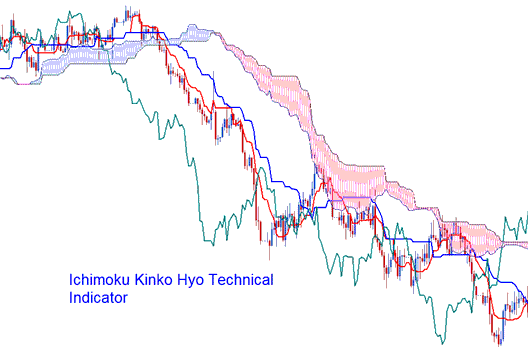
Ichimoku Kinko Hyo is a Japanese charting technique that was created before by a Japanese newspaper writer, with the pen name of Ichimoku Sanjin.
- Ichimoku means "a glance" or "one look"
- Kinko means "equilibrium" or "balance"
- Hyo is the Japanese word for "chart"
Thus, Ichimoku Kinko Hyo means, "a glance at an equilibrium chart". Ichimoku attempts to identify the likely direction of gold price & help the trader to figure out the most suitable time to enter or exit the gold trading market.
Calculation
This xauusd indicator consists of five lines drawn using the midpoints of previous highs and lows. The five lines are calculated as follows:
1) Tenkan-Sen: Conversion Line: Red Line (Highest High + Lowest Low) / 2, for last 9 gold price periods
2) Kijun-Sen: Base Line: Blue Line (Highest High + Lowest Low) / 2, for the last 26 gold price periods
3) Chikou Span: Lagging Span: Green Line Today's closing gold price drawn 26 gold price periods behind
4) Senkou Span A: Leading Span A = (Tenkan Sen + Kijun Sen) / 2, plotted 26 gold price periods ahead
5) Senkou Span B: Leading Span B: (Highest High + Lowest Low) / 2, for the past 52 gold price periods, drawn 26 gold price periods ahead
Kumo: Cloud: area between Senkou Span A & B
Gold Technical Analysis and How to Generate Trading Signals
Bullish signal - Tenkan-Sen crosses Kijun-Sen from below.
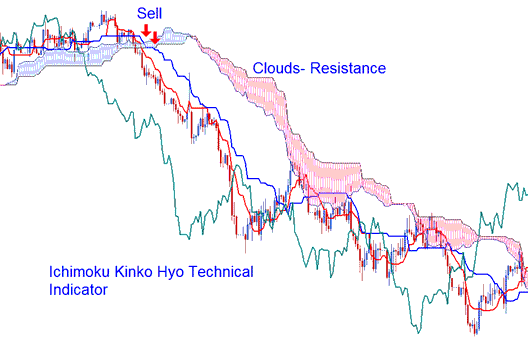
Bearish signal - Tenkan-Sen crosses the Kijun-Sen from above.
However, there are different levels of strength for buy and sell signals generated.
Technical Analysis in Gold Trading
Bullish crossover trading signal forms above the Kumo (clouds),
Very strong buy signal.
Bearish cross-over trading signal forms below Kumo (clouds),
Very strong sell signal.
If a bullish/ bearish cross-over trading signal takes place within the Kumo (clouds) it is considered a medium strength buy or sell trading signal.
A bullish cross-over that occurs below the clouds is considered a weak buy signal while a bearish crossover that occurs above the clouds is considered a weak sell signal.
Support and Resistance Levels
Support & resistance levels can be predicted by the presence of Kumo (clouds). Kumo can also be used to identify the current xauusd trend of the gold trading market.
- If gold price is above the Kumo, the prevailing market xauusd trend is said to be upwards.
- If gold price is below the Kumo, the prevailing market xauusd trend is said to be downwards.
Chikou Span or Lagging Span is also used to determine strength of the buy or sell signal.
- If the Chikou Span is below the closing gold price of the last 26 periods ago and a sell short signal is given, then the strength of the xauusd trend is downwards, otherwise the signal is considered to be a weak sell signal.
- If there is a bullish signal and the Chikou Span is above the gold price of the last 26 periods ago, then the strength of the xauusd trend is to the upside, otherwise it is considered to be a weak buy signal.